Wild Camping Legality Checker
Check Wild Camping Legality in the UK
Enter a UK location to see if wild camping is legal and what rules apply.
People often assume that if a patch of woods looks empty and quiet, it’s free for the taking. But in the UK, that’s not how it works. You can’t just pitch a tent anywhere you see trees. The truth is, wild camping in the UK is a patchwork of rules - some places allow it, most don’t, and breaking them can land you in trouble, even if you leave no trace.
Wild camping isn’t legal everywhere - and that’s the big misunderstanding
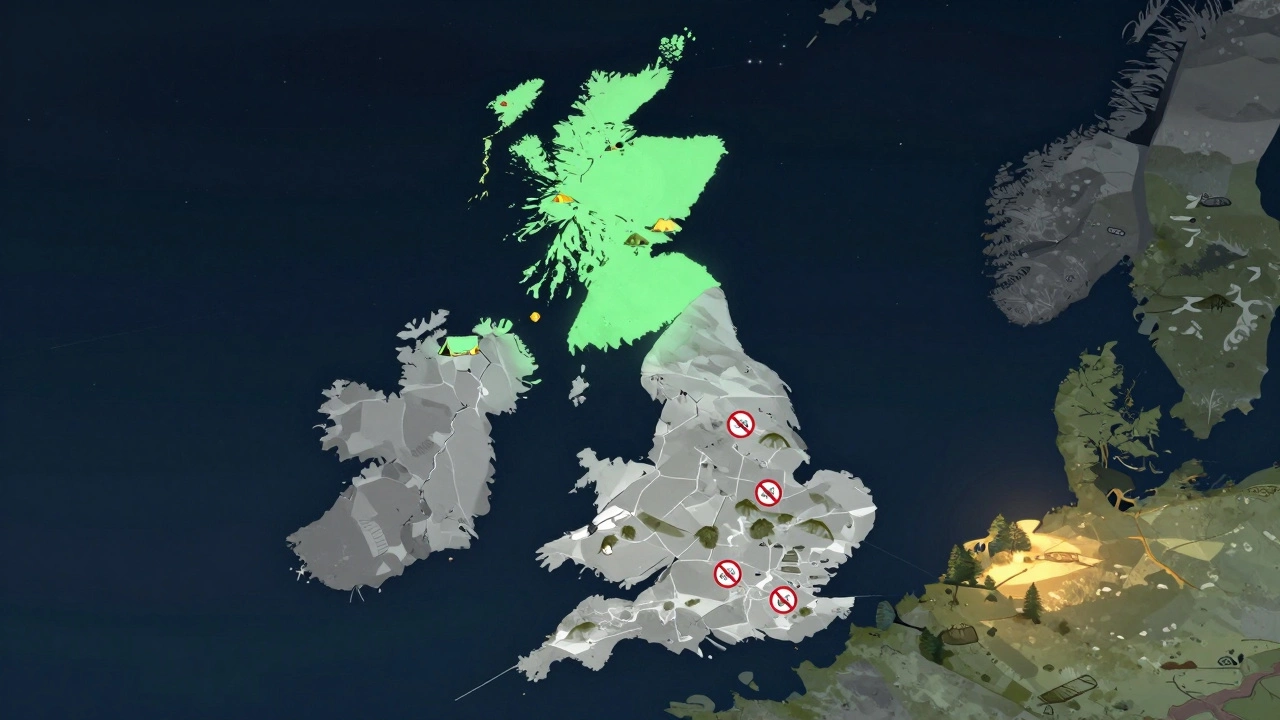
There’s a myth that Scotland is the only place in the UK where wild camping is allowed. That’s mostly true, but even there, it’s not a free-for-all. In Scotland, you can camp in most woods and hills under the Scottish Outdoor Access Code, as long as you follow three simple rules: be responsible, respect privacy, and leave no trace. But in England, Wales, and Northern Ireland, camping without permission is trespassing - no exceptions.
That means if you set up your tent in the New Forest, the Lake District, or even a quiet corner of the Brecon Beacons without landowner approval, you’re technically breaking the law. It doesn’t matter if you’re alone, quiet, or gone by sunrise. The land still belongs to someone - a private estate, a conservation group, or the Crown. And they can ask you to leave.
Scotland is the exception - but still has rules
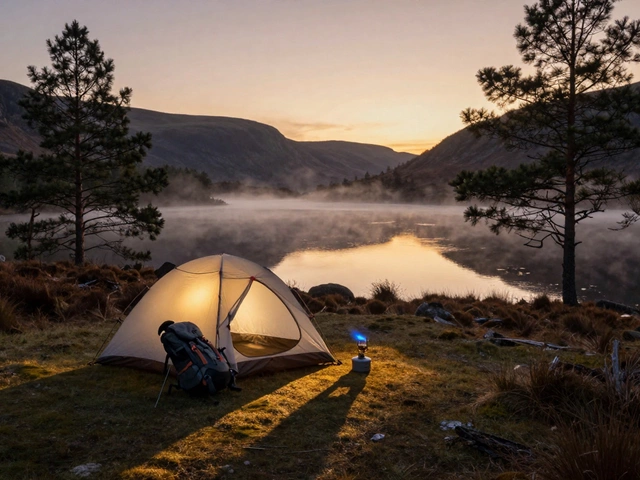
Scotland is the only part of the UK where wild camping is widely accepted and legally protected. You can camp in the Highlands, along lochs, or under pine trees in the Cairngorms without asking permission - as long as you follow the code.
Here’s what works:
- Camp in small groups - no more than 3 or 4 tents.
- Stay for no more than two or three nights in one spot.
- Avoid farmland, gardens, and buildings.
- Use a stove, not an open fire.
- Pack out everything - including toilet paper and food scraps.
Even in Scotland, you’ll get asked to move if you camp too close to a house, a popular trail, or a protected wildlife area. In 2023, the Scottish government issued 172 warnings to campers who ignored these rules near Loch Lomond. The message is clear: freedom comes with responsibility.
England and Wales: You need permission - and here’s how to get it
In England and Wales, wild camping is illegal unless you have the landowner’s permission. That doesn’t mean it never happens - many campers do it quietly, especially in remote areas like Dartmoor or the Pennines. But it’s a gamble.
There’s one major exception: Dartmoor National Park. Since 2023, a court ruling confirmed that wild camping is allowed on Dartmoor’s open moorland - but only on the high ground, not in enclosed fields or near buildings. You still need to follow Leave No Trace principles. This is the only place in England where wild camping is legally protected.
Elsewhere, your only safe option is to ask. Many small landowners - farmers, estate managers, woodland owners - will say yes if you approach politely. Some even charge a small fee, like £5 per tent. You’ll find lists of friendly landowners on sites like Wild Camp Sites or CamperMate. These aren’t official campsites - just private landowners who let campers stay.
Why the rules exist - and why they matter
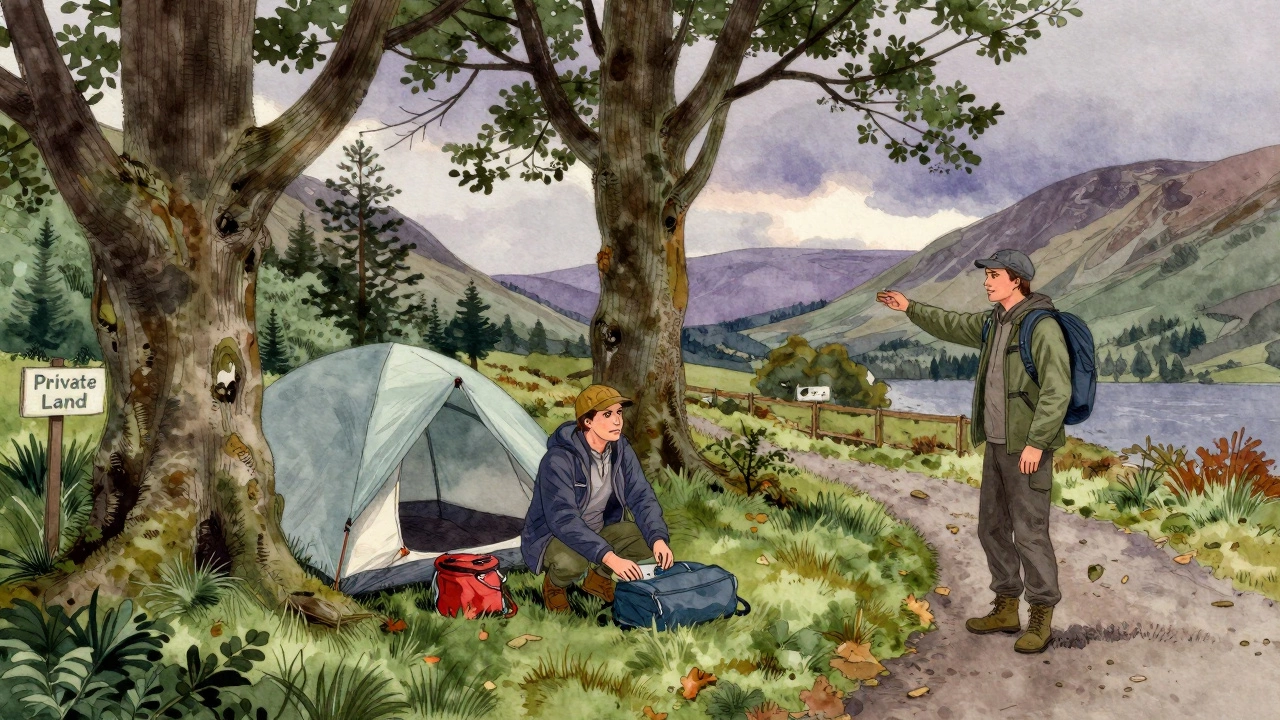
Why can’t you just camp wherever you want? Because the UK’s countryside isn’t empty. It’s full of farms, wildlife habitats, private homes, and protected ecosystems. One group of careless campers can trample rare plants, scare nesting birds, or leave behind waste that takes years to break down.
In 2022, the National Trust reported over 300 incidents of illegal camping in the Lake District alone. Many involved open fires that damaged soil, dog waste left near water sources, and tents pitched right on ancient burial mounds. The result? More restrictions. More signs. Fewer places where people can camp freely.
Wild camping isn’t about convenience. It’s about respect. The people who own the land, the animals that live there, and the next person who wants to experience the same quiet spot - they all matter.
What happens if you get caught?
If you’re caught wild camping illegally in England or Wales, you’ll usually be asked to leave. In most cases, that’s it. But if you refuse, or if you’ve caused damage, the landowner can call the police. Under the Criminal Justice and Public Order Act 1994, they can order you to leave and even seize your gear if you’re camping in a group of six or more.
Fines aren’t common for solo campers, but repeated offenses can lead to court orders banning you from certain areas. In 2024, a camper in the Peak District was banned from the region for two years after setting up camp on private land three times, despite multiple warnings.
The real cost isn’t the fine - it’s the loss of access. Every time someone ignores the rules, it becomes harder for everyone else to camp responsibly.
Safe alternatives: Where you CAN camp legally
You don’t need to break the law to enjoy the wild. Here are your best legal options:
- Dartmoor National Park (England): Legal wild camping on open moorland. Stick to high ground, avoid enclosed areas.
- Scotland: Follow the Outdoor Access Code. No permits needed.
- Low-impact campsites: Look for small, unofficial sites run by farmers or conservation groups. Many charge £5-£10 and are listed on apps like CamperMate or iOverlander.
- Dispersed camping on public land: In some areas, like parts of the North York Moors or the Forest of Dean, you can camp on designated public rights of way - but only if you’re hiking through and not staying overnight.
There are also hundreds of affordable campsites run by the Camping and Caravanning Club, the Youth Hostels Association, or local councils. They’re often just a short walk from wild areas - perfect for getting close to nature without crossing the line.
What to do if you want to camp in the woods - step by step
If you’re serious about wild camping, here’s how to do it right:
- Check the location: Use OS Maps or a reliable app to confirm if you’re on private land, a national park, or protected area.
- Know the rules: Scotland? You’re fine if you follow the code. England or Wales? You need permission.
- Find a friendly landowner: Search for wild camping permission + the area name. Many owners list contact info online.
- Call or email ahead: Be polite. Explain you’re a solo camper, will leave no trace, and will stay one night.
- Choose your spot wisely: Avoid fields, water sources, and paths. Pitch after dark, leave before sunrise.
- Leave it better than you found it: Pack out every bit of trash. Use a portable toilet if needed.
That’s it. No grand gestures. No risk. Just quiet, respectful access to the wild.
Why this matters beyond the law
Wild camping isn’t just about where you sleep. It’s about how you connect with nature. The best moments happen when you’re alone under the stars, with no noise but the wind. But those moments are fragile. They depend on people following the rules.
Every time someone camps illegally, it puts pressure on landowners to lock things down. More fences. More signs. Fewer chances for the next person.
If you want to keep wild camping alive in the UK, you don’t need to break the law. You just need to respect it.
Is it legal to camp in the woods in England?
No, it’s not legal to camp in the woods in England without the landowner’s permission. Most woods are privately owned, and camping without permission is considered trespassing. The only exception is Dartmoor National Park, where wild camping is allowed on open moorland under specific conditions.
Can you camp anywhere in Scotland?
You can camp in most remote areas of Scotland under the Scottish Outdoor Access Code, but not everywhere. You must avoid farmland, gardens, and buildings. Camp in small groups, stay no more than two or three nights in one place, and never light open fires. Follow the code, and you’re fine.
What happens if I get caught wild camping illegally?
You’ll usually be asked to leave. If you refuse, or if you’ve caused damage, the landowner can call the police. Under the Criminal Justice and Public Order Act 1994, they can order you to leave and seize your equipment if you’re in a group of six or more. Fines are rare for individuals, but repeated offenses can lead to bans from certain areas.
Are there any apps to find legal wild camping spots?
Yes. Apps like CamperMate, iOverlander, and Wild Camp Sites list private landowners who allow campers. These aren’t official campsites - just friendly farmers or woodland owners who charge a small fee. Always confirm before you go.
Can I camp on public footpaths in the UK?
No. Public footpaths are for walking only. You can’t legally camp on them, even if you’re hiking. Some people do it overnight, but it’s still trespassing. If you want to camp, find a designated spot or get permission from the landowner.
Final thought: The wild isn’t free - but it’s still yours to enjoy
You don’t need to break the law to feel the freedom of sleeping under the stars. The UK’s wild places are beautiful, but they’re also shared. The rules exist not to stop you, but to protect the land - and the experience for everyone who comes after you.
Respect the law. Respect the land. And you’ll always have a place to camp - legally, safely, and quietly.