Camping Power Calculator
Calculate your power needs for generator-free camping trips based on your devices, duration, and solar charging options.
Your Devices
Trip Details
Your Power Requirements
Solar Charging Estimates
100W Solar Panel:
Charging Time Needed:
Based on full sun
You’re parked under the stars, the fire is crackling, and your phone is at 3%. You didn’t bring a generator-and now you’re wondering how you’re going to charge your lights, phone, or mini-fridge. The good news? You don’t need a noisy, gas-guzzling generator to keep your gear powered while camping. Thousands of campers in Australia and beyond do it every weekend using simple, quiet, and reliable alternatives.
Start with a portable power station
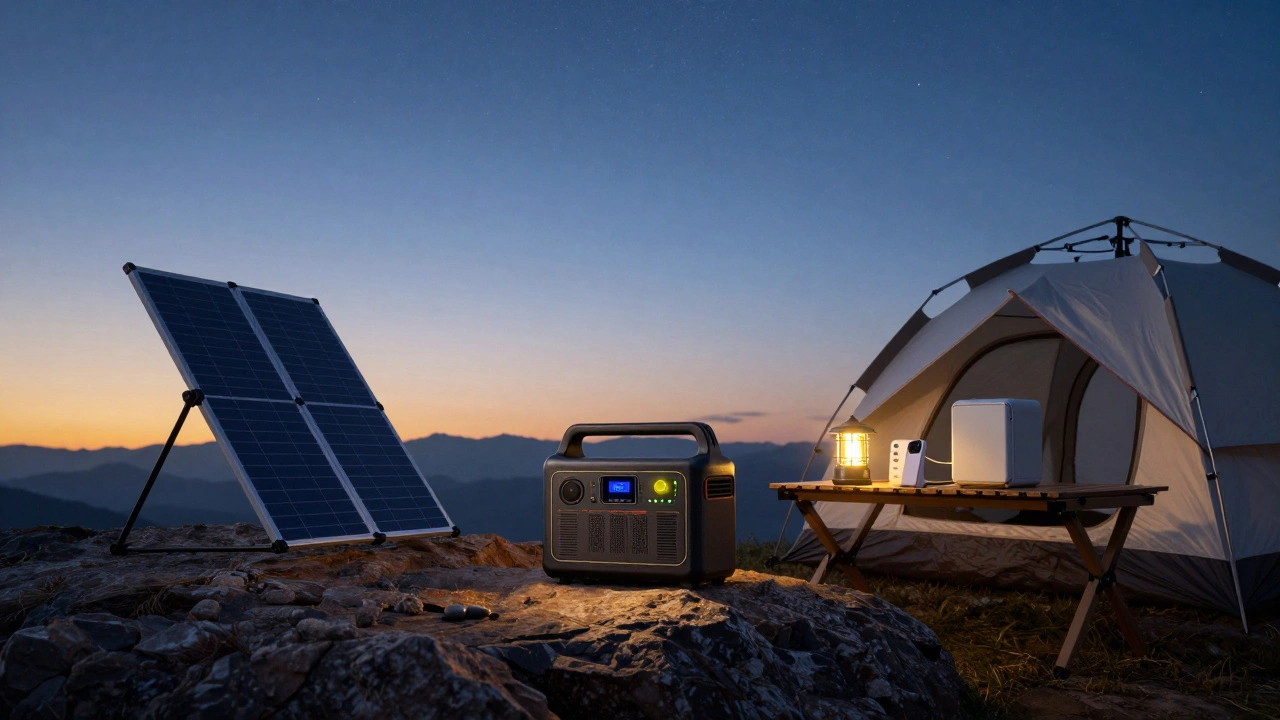
A portable power station is the most straightforward replacement for a generator. These are compact, rechargeable batteries with AC outlets, USB ports, and sometimes 12V car ports. Brands like Jackery, EcoFlow, and Anker make models that weigh less than 10 kg and can run a small fridge for 8-12 hours or charge a phone 20+ times.
Look for one with at least 300Wh capacity if you’re powering basic gear like LED lights, a phone, and a Bluetooth speaker. If you plan to run a mini-fridge or a CPAP machine, go for 500Wh or more. Most units charge via solar panels, wall outlets, or your car’s 12V port-so you’ve got options.
One camper in the Blue Mountains charges their 500Wh unit overnight using a 100W solar panel and runs a 40L fridge, phone, and headlamp for three days straight. No fuel. No noise. No fumes.
Use solar panels-smartly
Solar isn’t magic. It’s physics. And it works best when you understand how to use it.
A 100W foldable solar panel costs around $150 and can produce 300-500Wh per day in full sun. That’s enough to fully charge a 500Wh power station in 1-2 days. In cloudy weather? Expect half that. Rain? Forget it.
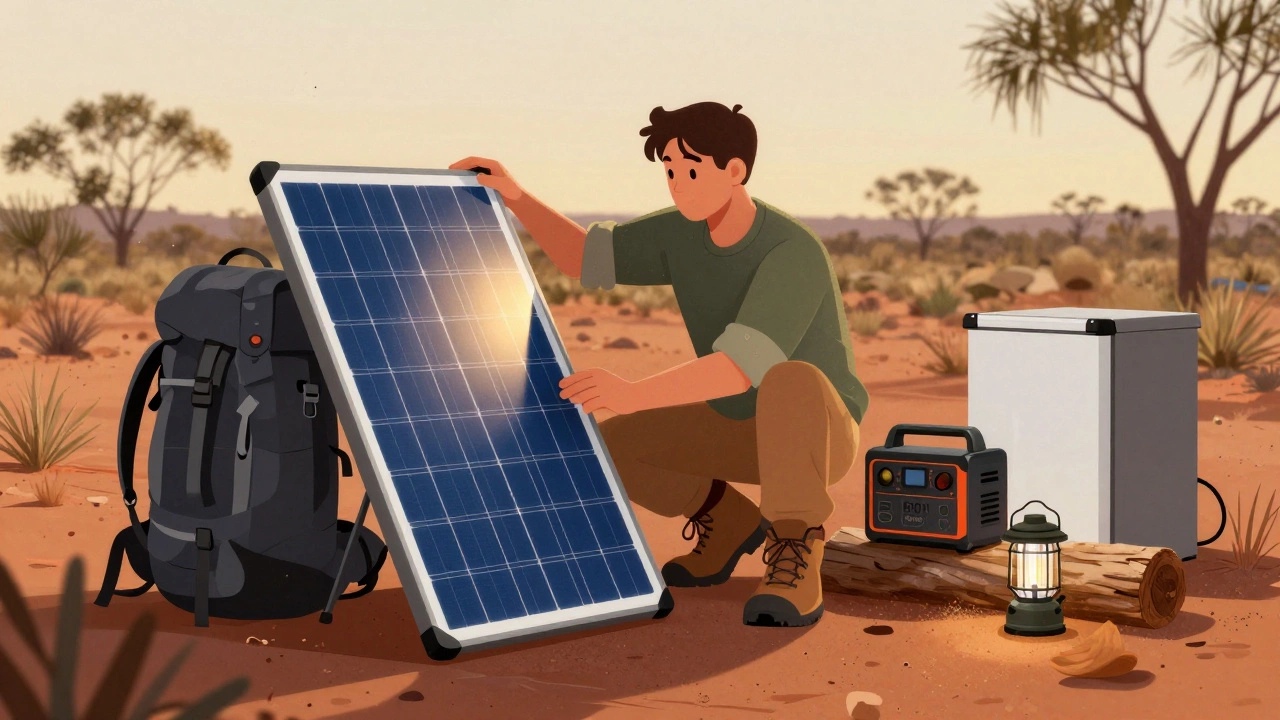
Here’s the trick: Don’t just lay the panel on your car roof and hope. Angle it toward the sun. Use a stand or prop it up with a backpack. Clean the surface every few days-dust cuts efficiency by up to 25%. And pair it with a power station, not directly with your devices. Solar panels output unstable voltage. Power stations smooth it out and store it safely.
Many campers in Queensland use a 100W panel with a 600Wh power station. They leave the panel out all day while hiking, then plug in their phone and headlamp at night. Simple. Reliable.
Bring extra batteries
Not everything needs to plug into a wall. Many camping essentials run on standard batteries.
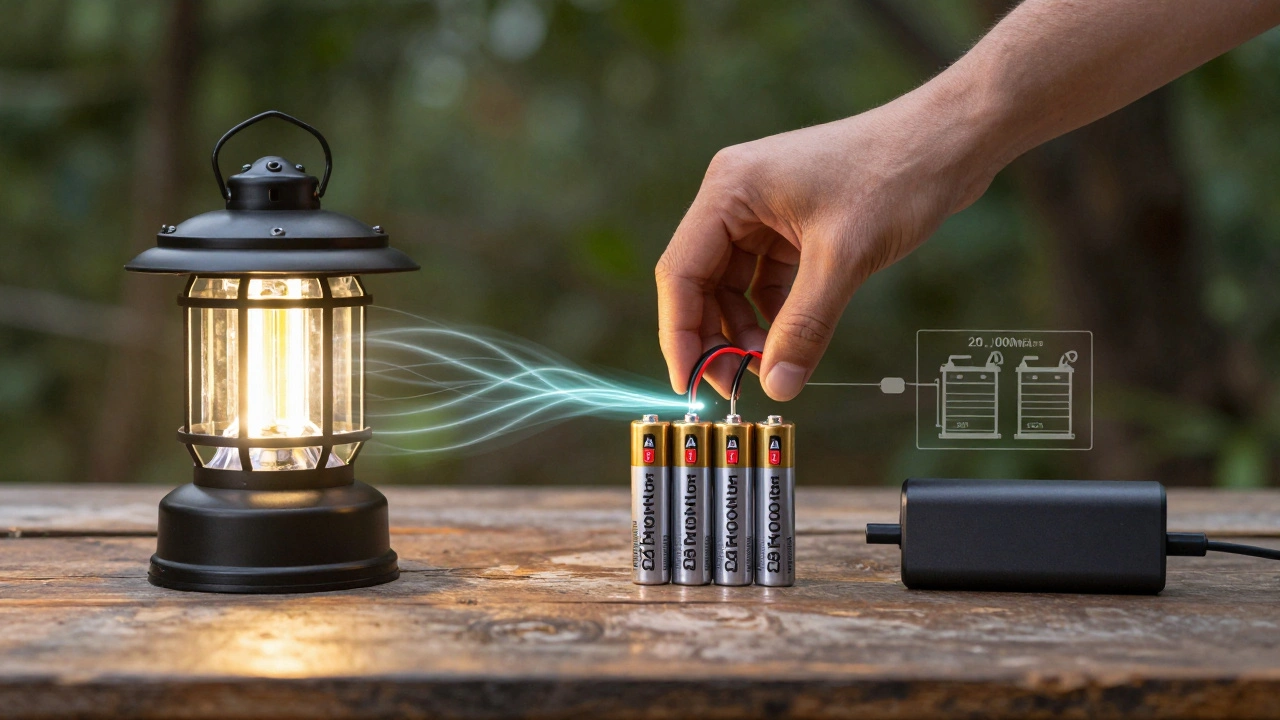
LED lanterns? Use AA or D-cell lithium batteries-they last 3x longer than alkaline and work in cold weather. Headlamps? Rechargeable 18650 lithium-ion cells are cheap, lightweight, and easy to swap. A set of 4 lasts a week with moderate use.
Keep a small pack of spare batteries in a waterproof case. Charge your rechargeables before you leave. Use a solar-powered USB battery pack as a backup for your phone. Even a 10,000mAh power bank can give you 3-4 full phone charges.
One family in Tasmania brought 6 rechargeable D-cells for their lanterns and a 20,000mAh power bank. They never plugged into anything. Their gear lasted 7 days.
Use your vehicle’s battery (safely)
If you’re camping in a car, van, or 4WD, your engine’s alternator can charge a second battery. But you need the right setup.
Install a dual battery system with a DC-DC charger. It pulls power from your car’s alternator while driving and safely stores it in a deep-cycle battery. When you stop, you can draw from that battery without draining your starter battery.
Don’t just plug a power strip into your cigarette lighter. It can’t handle more than 100W, and running a fridge for hours will kill your car battery. A proper dual battery setup costs $300-$600 but lets you run a fridge, lights, and phone charger for days-even with the engine off.
Van lifers in Western Australia rely on this method. One setup with a 100Ah lithium battery and 100W solar panel runs a fridge, LED lights, and two phones for a week without touching the engine.
Choose low-power gear
Power isn’t about how much you have-it’s about how little you need.
Replace incandescent lanterns with LED. A 3W LED lantern uses 1/10th the power of a 30W bulb. Swap your 120W camping microwave for a 45W insulated cooler that keeps food cold without power. Use a manual can opener instead of an electric one.
Check the wattage on every device. A phone charger? 5W. A Bluetooth speaker? 10W. A 12V fridge? 40W. Add them up. If your total draw is under 100W, you can run it for hours on a small power station.
One couple in the NSW South Coast switched to a 12V fridge (35W), LED lights (5W), and a 10W speaker. Their 300Wh power station lasted 4 days. They didn’t touch solar once.
Plan your power use
Power management is half the battle. You can have the best gear, but if you leave your lights on all night, you’ll run out fast.
Use a checklist:
- Charge everything before you leave.
- Turn off devices when not in use.
- Use battery-powered gear where possible.
- Run high-draw devices (like a fridge) during daylight if using solar.
- Limit phone use. Put it on airplane mode. Use a physical map.
Keep a small notebook or phone note to track usage. If your 500Wh station drops to 200Wh by day 2, you know you need to cut back.
What NOT to do
Don’t try to power a kettle, microwave, or hair dryer off a portable battery. These draw 800-1500W. Even the biggest power stations can’t handle that for more than a few minutes.
Don’t plug a generator into your power station. It can fry the internal circuits.
Don’t leave lithium batteries in direct sun or freezing cold. Heat and cold kill their lifespan. Store them in a shaded, insulated spot.
Don’t assume all solar panels are created equal. Cheap ones from unknown brands often don’t deliver the advertised wattage. Stick to reputable brands with real reviews.
Real-world example: A weekend in the Grampians
Last month, a group of four camped in the Grampians for three days. No generator. No electric hookups.
They brought:
- One 600Wh portable power station
- One 100W foldable solar panel
- Two 20,000mAh power banks
- Four LED lanterns (AA lithium batteries)
- One 12V fridge (40W)
They charged the power station via solar during the day. At night, they ran the fridge, charged phones, and lit up the campsite. They had 15% battery left on the last night.
They didn’t miss a thing. No noise. No smell. No fuel stops.
Final tip: Start small, then scale
You don’t need to buy a $1,000 system on day one. Start with a $100 power bank and a $50 solar charger. Test it on a one-night trip. See how your gear performs. Then upgrade.
Most people who switch from generators to solar and batteries never go back. It’s quieter. Cleaner. Cheaper in the long run. And honestly? It just feels better to camp without the hum of a machine.
Can I use a car battery directly to power my camping gear?
Not directly without risking your car’s ability to start. Car batteries aren’t designed for deep discharges. If you drain them too much, they’ll die. Use a dual battery system with a DC-DC charger to safely tap into your vehicle’s power without harming the starter battery.
How long does a portable power station last when camping?
It depends on what you’re powering. A 300Wh station can run a 5W LED lantern for 60 hours, a 40W fridge for 7-8 hours, or charge a phone 20 times. Add more devices, and the runtime drops. Always check the wattage of each item and plan accordingly.
Is solar power reliable in cloudy weather?
Solar still works in overcast conditions, but output drops by 50-70%. A 100W panel might only produce 20-40W. That’s enough to top up a power station slowly, but not enough to fully recharge it in one day. Always pair solar with a power station so you have stored energy for cloudy days.
Can I charge a power station while driving?
Yes, if your power station has a 12V car charging port. Most do. Plug it into your vehicle’s cigarette lighter or 12V outlet while driving. It won’t charge as fast as solar, but it’s a good backup. Just make sure your car’s alternator can handle the load-most modern vehicles can.
What’s the cheapest way to get power while camping?
The cheapest way is using spare batteries and low-power gear. Buy AA lithium batteries for lanterns and headlamps, use a 10,000mAh power bank for your phone, and avoid high-wattage devices entirely. You can get through a weekend for under $50 in supplies.